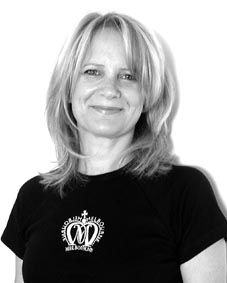
STEFANO BOSCUTTI: How would you describe Melbourne's style?
MAREE COOTE: Very different to any other city really because it's such a unique mix of people and histories and cultures. Food and design, and fashion and society play a big part in our way of doing things here. We have more of a mind culture, and an arts culture in this city. We like different things.
SB: Different things?
MC: There are a lot of great stories in the history of the city that I don't think get showcased enough. So at Melbournestyle we're looking at bringing them out a little more through books, or through gifts, even Melbourne Cups and Saucers! - through all kinds of artistic means to celebrate the history of the city. Not just the white history, but the black history and our cultural, and multi-cultural history. We're looking to showcase Melbourne makers and tell Melbourne stories and encourage Melbourne production and an awareness of our differences as a city.
SB: Why make a virtue of our differences?
MC: I don't think we want to lose what makes us unique. Globalism makes everything feel the same. But personally if I go to Rome, I want to feel like I'm in Rome, and if I go to Melbourne, I want to feel like I'm in Melbourne. I don't want to see the same stuff for sale and I don't want to go to the same movies and I don't want to eat the same food. I want all the things that make a city unique. I want a unique experience.
SB: So what makes Melbourne unique?
MC: Its 'considered' nature... its authentic nature. It doesn't seem to be as brash as some other cities. Melbourne hasn't lost its sense of identity.
SB: Not yet?
MC: There's been a lot of new development, so lot of the old stuff has gone and a lot of new stuff has come in. Some of it good, some of it shocking. There's a risk that when you junk your history, you can junk some of the stories that go with it. They're our communal memories, they link us together.
SB: What does Melbourne have that no other city has?
MC: A blend of cultures, a blend of food and fashion and arts that comes from so many different places. Particularly European because that was the first influx. Historically, the gold rush brought so many people from so many places from all around the world in the 1850s. Other cities don't have that foundation, that mix. It brought with it coffee and fashion, and theatre and all sorts of things. A kind of an internal culture, not an external culture. An intellectual culture and an appreciation of the gorgeous things of life, like painting and gilded frames, theatre, sculpure and good design, and eye for fashion. We have such rich details to enjoy thanks to all of that. We have beautiful gardens and the bay... and the river - only just now starting to be really celebrated properly.
SB: What's the main attraction for overseas visitors?
MC: Overseas visitors are always surprised at how sophisticated a city it is. They think it looks great and they think that the people are smart and stylish. I think it's a surprise for them because they expect the Bondi/Aussie type. But they don't get that when they come to our city. We're more indoors/intellectual, less body culture, more cultured.
SB: Are all the products by Melbourne artists?
MC: Yes lots of Melbourne artists, designers, jewellers, photographers, illustrators, writers. But also some fabulous designs from overseas too, Spain, USA, Scandinavia - when we see gorgeous work, sometimes we can't resist getting it in.
SB: But you aim to showcase 'made in Melbourne'?
MC: Yes, as much as possible. Most items are completely made in Melbourne. But a lot of the industries here have shut down. So, with some pieces, like some of the ceramics, we import the basic item. But then we do all the design and decoration here. Hopefully more and more manufacturing will come back to us. We've recently started to manufacture our own giftware. We now have our own manufacturing division and we've invested in some plant to be able to create our own homewares, accessories and giftware.
SB: The joys of manufacturing, eh?
MC: I love it. Very hands on. I'll give anything a shot. It's a big experimental phase at the moment. But there's no way designers can be in the frontline with design unless they have their hands on the technology. I don't see how you can sit and imagine what you might be able to do with a paintbrush if you haven't got one. And until you have one, you don't know that you can use it this way, or that way, or the other way. If you actually say, 'well I've got the idea but I'll send it to China or India and get someone else to make it', they'll invest the time and the money there to get the plant and machinery together. So they're the ones who are going to say, 'okay we'll do what you ask but we've just realised it can also do this, that and the other thing as well' and they will overtake you in the design stakes. They just have to, it's logic. The technology is part of the design process. You can't sit and imagine the unlimited possibilities for painting if you haven't got the paintbrush in your hand.
SB: So we have to manufacture here?
MC: Absolutely. We need to have manufacturing here in some form or another, or we'll actually lose the creative edge that we have. It's part of the creative process. One thing leads to another thing. If I write a book and there's a character in it, I want to develop that into 3 dimensions and then extend it into another product area again...and when I start working in one medium I think 'oh this is a good medium for toys or jewellery or lighting, ...you know, one thing leads to another.
SB: What's the steps from the idea to on the shelf, what's that process?
MC: Very, very direct. I barely even sketch up an idea anymore. It forms itself so quickly in my head, I think, 'oh I I'll try this in leather' or whatever, and go and make it. You get the idea, you think it through, you work it up as soon as you can - or i do anyway. I pretty well go straight from the idea to the art file for printing or manufacturing.
SB: Is that weeks or months?
MC: Usually the same day! I'm very impatient so if I have an idea, I'll try and draw up the file straight away, and either get into the workshop, factory, onto a computer or the machinery or get a file to the printer as soon as I can.